


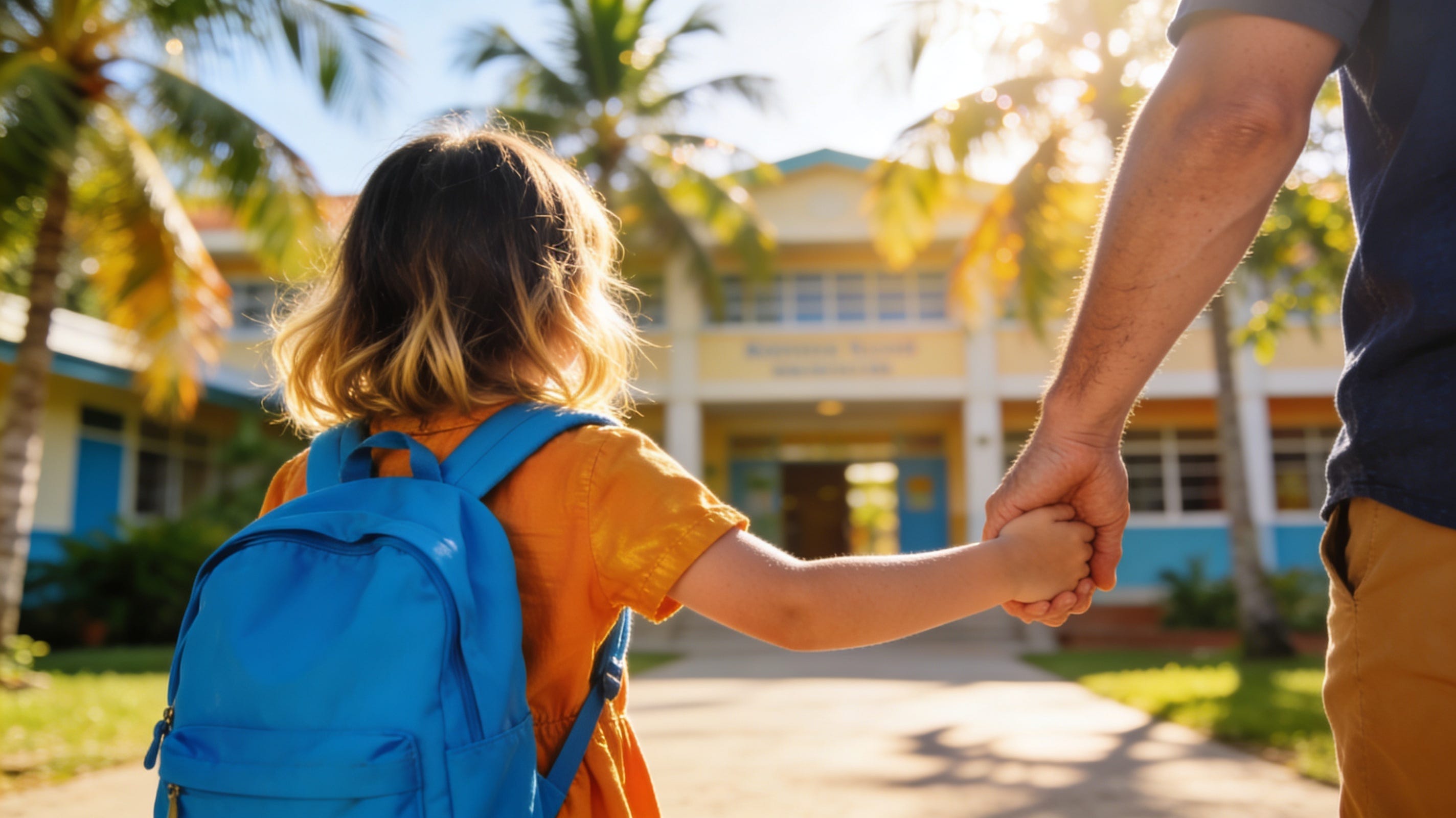
A few months ago my wife and I paid $366 to sign our nine-month-old up for school in 2029. This is just to be put on a list, position unknown. A list that guarantees nothing but consideration to register at the school. The payment is non-refundable, and not put towards any future fees. There will naturally be an actual registration fee and deposit due if her position on the list entitles her to attend the school when we get closer to the time.
After procrastinating for months, including considering moving to multiple other countries instead of paying this ridiculous fee, my wife and I gave in and paid it. In return we got this:
Please find our payment receipt for your child’s 2029 registration fee attached to this email. As a gentle reminder this is not confirmation of placement but does secure her spot on the list.
Cheers!
Across these beloved Cayman Islands, mothers and fathers dig into their pockets and make this involuntary school donation because there is no other choice. School space is limited for our ever-growing population. You wouldn’t want your child left out.
Caymanians who believe in the public education system can send their kids to government school for free. Technically everyone else can also send their kids to a government school but for a fee. $900-$15001 per annum plus external exam fees. That seems fair for the second most expensive place in the world2.
But due to very limited space, 46.7% of Primary School Children and 40.9% of high school children attend private schools.3 The high demand for education and low supply means the government must enforce a hierarchy of who gets placed first.
The admission hierarchy at government schools is: Caymanians and status holders first, then refugees and asylum seekers, then dependents of Caymanians, then dependents of government workers, then permanent residents, then everyone else if space allows.4 Space very rarely allows.
By not building enough public schools to meet the exploding population demand because, as then Finance Minister Rolston Anglin put it to a Finance Committee, the forecasting is “very unscientific,” the government has inadvertently created a market for eager capitalists to exploit. And exploit it they have.
Private schools currently charge anywhere from a whopping $18,000 to $36,0005 per annum with specialized support schools pushing that even higher. That’s a lot of money to give our little darlings an education, an education that they are only kind of, sort of entitled to.
The Cayman Islands Constitution doesn’t actually guarantee free education. Section 20 of the Bill of Rights says the government will “seek reasonably to achieve the progressive realisation, within available resources, of providing every child with primary and secondary education which shall [...] be free.”6 A sentence with so many hedges in it, it’s almost an apology in advance. We’ll try, if we can, maybe when there is money available, to move towards making school for all kids free.
In a country like Cayman, a wealthy developed tax haven, not a developing country, almost half the school-age population has no access to free education. Their parents, whose work permits and immigration fees fund a meaningful share of government revenue, do not even have the option of sending their children to public school.
I’m all for allowing the private sector to step in when the government can’t. Provide a premium service for those willing to pay for it. But with demand through the roof and supply short, basic economics means you’ll soon be selling your liver just so Johnny can learn to read.
There are of course consequences far beyond making expats pay through their noses to educate their offspring. The undersupply of government education, leading most expats to send their kids to private schools, could be inadvertently contributing to the us versus them dynamic that plagues us today.
People like to stick to what they know. I see it in Cayman all the time. People from the same country end up almost exclusively hanging out with other people from their country. It’s a disservice to yourself and the people of Cayman. But it’s human nature. Integration needs to be actively built into society or we will naturally stick to our tribes.
When kids share a classroom, their parents eventually end up spending a lot of time together. Time spent doing life with people is what leads you to discover that the person who looks different and comes from a different background is also exhausted, also proud of their kid, also trying to make the best life for their family, also winging it. You discover that we are more alike than different.
I grew up in South Africa in a time when the country was actively trying to undo a system that had sorted people by race into separate classrooms, separate neighbourhoods, separate lives. Separating people sows distrust and animosity based on lies and hearsay instead of truth. It creates immeasurable damage. Damage that will take multiple generations to recover from.
By being in the classroom with kids who came from historically disadvantaged backgrounds, and then the lecture hall, and then the workplace, I learnt what the generations before me never could. These people that are different from me are just as smart if not smarter, they work just as hard if not harder and they have had to make incredible sacrifices to get themselves to the positions they are in today. They are just like me, maybe better.
Having a braai (BBQ) in each other’s homes, shouting for the same sports team, celebrating your commonalities and laughing at your differences. These are things that South Africa does well and has been the source of much of the healing that has taken place so far.
These are things that make a cohesive society. I want my daughter to have friends from every walk of life and every nationality on this island. To make real connections that will give her friends to visit in countries all over the world while also feeling comfortable to call this place home. Where the government has dropped the ball, parents will have to step up. We must actively reach across the divides to build the society we want our kids to inherit. All while coughing up $366 to get them on a list they just have to be on.
Rounded values in USD, sourced from Cayman Parent.
According to a 2024 Education Data Report cited in Cayman Parent.
According to the official government education website at the time of publishing: schools.edu.ky